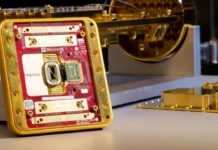
Quantum computing is one of the most exciting frontiers of science and technology, and at its core is a fundamental concept: the qubit. Unlike the traditional bits that have been the basis of classical computing, qubits possess unique properties that could transform the digital world as we know it. But what makes a qubit so special, and how does it work?
What is a Qubit?
A qubit, or quantum bit, is the basic unit of information in quantum computing. While a bit in a classical computer can only be in a state of 0 or 1, a qubit can be in superposition, meaning it can simultaneously represent both values.
In addition, qubits can be entangled, a quantum property that allows two or more qubits to be connected in a way that the state of one instantly affects the other, no matter the distance between them.
These properties make qubits incredibly powerful and allow for much faster and more efficient calculations compared to classical systems.
Main Properties of Qubits.
1.Overlay: More than one state at a time.
In classical computing, a bit can only be in a specific state: 0 or 1. Instead, a qubit can be in a combination of both states at the same time. This means that a quantum computer can process multiple calculations simultaneously, speeding up the resolution of complex problems.
2.Entanglement: Instantaneous quantum connection.
When two qubits are entangled, any changes in one of them will automatically affect the other, no matter how far apart they are. This property is key to improving efficiency in data transmission and processing in quantum systems.
3.Quantum Interference: Controlling probabilities.
Quantum interference allows qubit states to be manipulated to direct calculations towards correct answers and avoid errors. It is a crucial property for the development of efficient quantum algorithms.
How Do You Build a Qubit?
There are different ways to build qubits today, and each approach has its advantages and challenges:
- Superconducting qubits: Used by companies like Google and IBM, they work with superconducting circuits cooled to temperatures close to absolute zero.
- Trapped ions: Used by IonQ and Honeywell, these qubits are individual atoms manipulated with lasers in vacuum chambers.
- Quantum dots: Small semiconductors that can function as qubits thanks to the manipulation of electrons.
- Photons: Qubits of light that can be transported through optical fibers to develop secure quantum communications.
Why Are Qubits Important?
Qubits open the door to a new era in computing, with applications ranging from cryptography to artificial intelligence. Some of the most prominent benefits include:
- Quantum cryptography: More secure algorithms that could make current encryption techniques obsolete.
- Medicament discovery: Simulating molecules and chemical reactions with unprecedented accuracy.
- Process optimization: Solving logistical and design problems in seconds instead of years.
- Material simulation: Creating new materials with revolutionary properties.
Challenges in the Creation and Use of Qubits.
Despite their enormous potential, qubits are extremely fragile. Factors such as ambient noise, temperature, and vibrations can cause them to lose their quantum state in a phenomenon known as quantum decoherence.
Scientists are working on various strategies to improve quantum error correction, which will allow more stable and scalable quantum computers to be built in the future.
Qubits represent the heart of quantum computing and are the key to unlocking a new world of technological possibilities. Although we are still in the early stages of its development, its impact on science, industry and everyday life will be revolutionary.
The question is no longer whether quantum computing will change the world, but when.
Are we ready for this new quantum era?